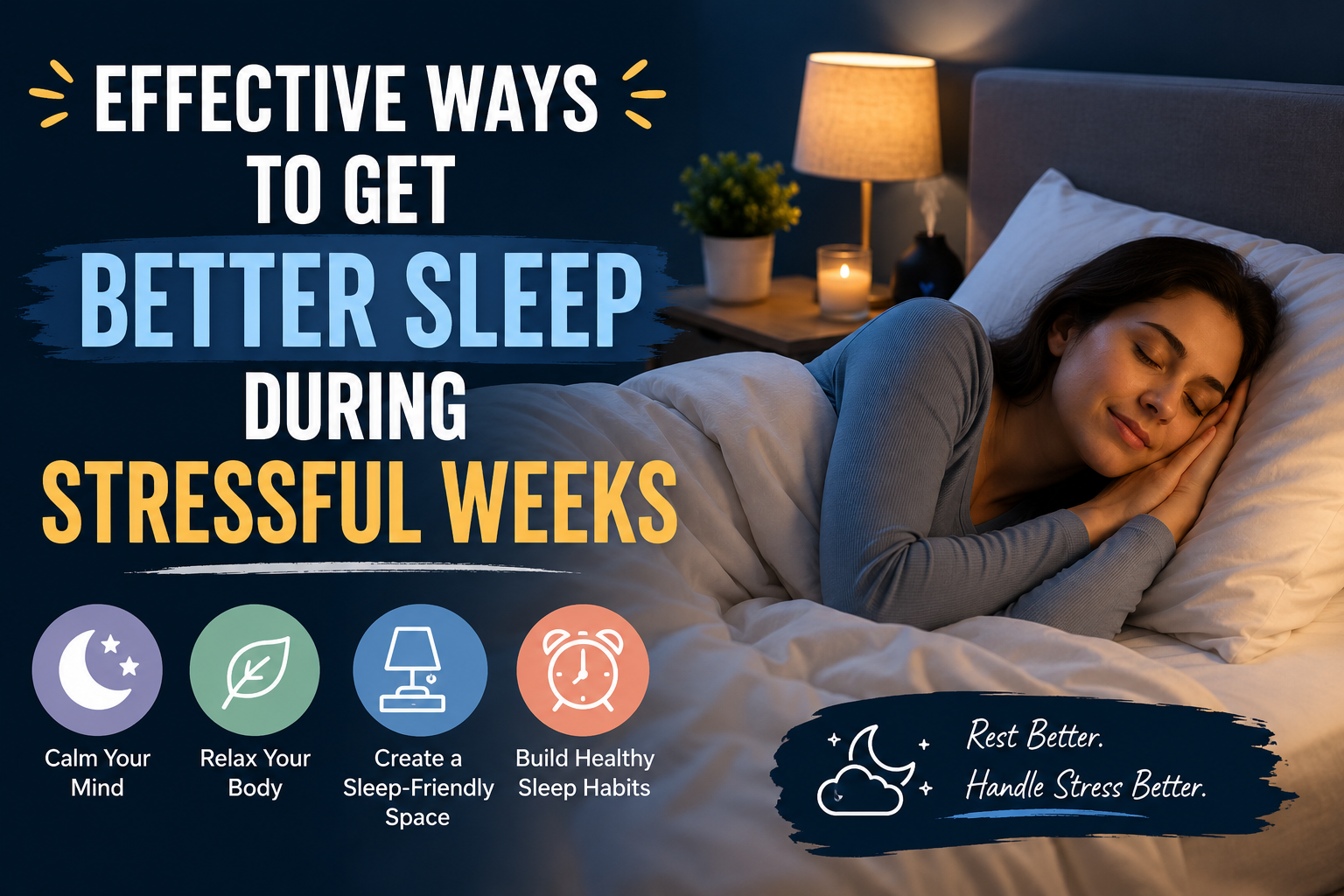
Stressful weeks can make sleep surprisingly difficult. You may feel exhausted all day, only to become wide awake once your head hits the pillow. Work deadlines, financial concerns, family responsibilities, unfinished tasks, and even worrying about getting enough sleep can keep your mind active when you want it to slow down.
If you want to get better sleep during stressful weeks, the goal is not to create an elaborate nighttime routine or force yourself to fall asleep. A more practical approach is to protect a few basic sleep habits, reduce unnecessary stimulation before bed, and give your mind a predictable transition from a demanding day into rest.
Stress itself is recognized as a factor that can contribute to short-term insomnia, and worrying about sleep can sometimes make the problem worse.
Here are practical ways to make sleep easier during periods when life feels especially busy.
Why Stress Can Make Sleep More Difficult
Sleep and stress can easily create an unpleasant cycle.
A stressful day may leave you thinking about tomorrow while you are trying to sleep. Poor sleep can then leave you more tired and less able to concentrate the following day, making your responsibilities feel even harder to manage.
You may notice yourself doing things such as:
- Replaying conversations in your head
- Thinking through tomorrow’s schedule
- Checking the clock repeatedly
- Answering emails from bed
- Trying to solve work problems late at night
- Worrying about how tired you will be tomorrow
The solution is not necessarily to eliminate stress before you sleep. During a difficult week, that may not be realistic.
Instead, focus on creating conditions that make it easier for your body and mind to transition toward sleep.

1. Protect Your Wake-Up Time
When you sleep badly, sleeping much later the next morning can feel tempting.
Occasionally getting extra rest is understandable, but large swings in your sleep schedule can make your sleep-wake rhythm less predictable. Maintaining reasonably consistent bed and wake times is a standard healthy-sleep recommendation from the National Heart, Lung, and Blood Institute.
During a stressful week, your wake-up time may actually be easier to control than your bedtime.
Try to wake up at approximately your normal time, then allow your bedtime to come naturally as you become sleepy.
This does not mean forcing yourself to function on too little sleep. It simply means avoiding a completely different sleep schedule every time you have a difficult night.
2. Give Yourself Enough Time to Sleep
One of the simplest sleep strategies is also one of the easiest to ignore: leave enough time for sleep in your schedule.
Adults generally need about seven to nine hours of sleep, although individual needs vary.
During busy weeks, sleep often becomes the flexible item that gets pushed later:
“I’ll finish one more email.”
“I’ll clean this up before bed.”
“I’ll watch one more episode.”
“I need to prepare everything for tomorrow.”
Eventually, midnight arrives even though you have to wake up early.
If you already know when you need to get up, work backward and protect a realistic sleep window. You do not have to fall asleep at an exact time, but continually cutting into the opportunity to sleep makes the problem harder to solve.
3. Create a Short Wind-Down Routine
Your brain does not always shift immediately from work mode into sleep mode.
Going directly from answering emails, solving problems, or handling family responsibilities to lying in a dark room may leave your mind operating at the same pace.
Create a simple transition before bed.
A wind-down routine could include:
- Dimming the lights
- Taking a warm shower or bath
- Reading something relaxing
- Listening to quiet music
- Gentle stretching
- Preparing a few things for tomorrow
- Putting your phone away
NHLBI recommends using the period before bedtime for quiet activities and reducing bright artificial light. Relaxation techniques and a calming routine may also be useful.
Build a Repeatable Sequence
Your routine does not have to be impressive.
Something as simple as:
Brush teeth → prepare tomorrow’s clothes → dim lights → read → bed
can give your evening a predictable ending.
During stressful weeks, simplicity matters. A routine containing eight different wellness activities may become another task you feel guilty about not completing.
Choose a few things you can realistically repeat.

4. Get Tomorrow’s Worries Out of Your Head
Sometimes the problem is not your bedroom. It is the unfinished list running through your mind.
You remember an email you need to send.
Then a bill.
Then something your child needs.
Then tomorrow’s meeting.
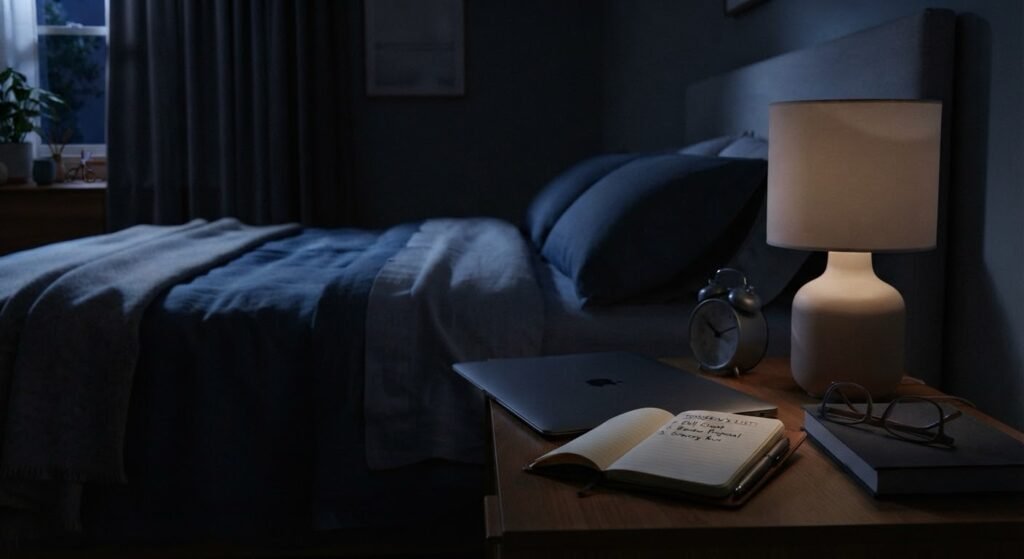
Instead of trying to remember everything until morning, write it down before getting into bed.
You could keep a small notebook and make two short lists:
Tomorrow
- Send project update
- Call insurance company
- Pick up groceries
Not tonight
- Reorganize office
- Research new laptop
- Plan next month’s schedule
The purpose is not to create a complicated productivity system.
It is simply to give your brain somewhere to put unfinished thoughts so you do not have to keep mentally rehearsing them.
If you remember something later, write it down and return to resting rather than beginning the task.
5. Reduce Evening Screen Stimulation
Screens are not automatically the reason someone sleeps poorly, but late-night device use can make winding down harder.
There are two separate issues.
First, bright artificial light at night can interfere with signals involved in your normal sleep-wake rhythm.
Second, what you are doing on the device matters.
Watching a calm video is very different from:
- Answering stressful work emails
- Reading upsetting news
- Arguing on social media
- Checking tomorrow’s workload
- Scrolling endlessly through short videos
During a stressful week, try creating a cutoff point for activities that activate your brain.
You may still use your phone for music, an alarm, reading, or another quiet activity, but consider moving stressful tasks away from the final part of your evening.
6. Be Strategic With Caffeine
When you are tired from poor sleep, caffeine can become part of another cycle:
Poor sleep → extra caffeine → difficulty sleeping → more caffeine tomorrow.
Caffeine blocks processes involved in normal sleep pressure, and its effects can persist for hours. NHLBI notes that caffeine late in the day can interfere with falling asleep.
You do not necessarily need to stop drinking coffee altogether.
Instead, pay attention to when you consume caffeine.
Sources can include:
- Coffee
- Tea
- Energy drinks
- Some soft drinks
- Chocolate
- Certain medications or supplements
If falling asleep has become difficult, consider moving your last caffeinated drink earlier and see whether your sleep improves.
Sensitivity varies from person to person, so your own response matters.
7. Avoid Using Alcohol as a Sleep Aid
Alcohol can make some people feel sleepy initially, which makes it tempting during stressful periods.
However, feeling sleepy after drinking alcohol does not necessarily mean you will get better-quality sleep. NHLBI notes that alcohol before bed can contribute to lighter sleep and more nighttime awakenings.
If your objective is more reliable sleep, using alcohol specifically as a bedtime strategy is not a good substitute for a stable routine.
8. Make Your Bedroom Work for Sleep
You cannot control every stressful event occurring during the day, but you may have more control over your bedroom.
A sleep-friendly room is generally:
- Dark
- Quiet
- Comfortable
- Cool enough for you to sleep comfortably
NHLBI specifically recommends a cool, quiet, dark sleep environment.
Look for obvious problems first.
Maybe light from outside shines directly through your window.
Perhaps notifications keep waking you.
Maybe your room becomes uncomfortably warm overnight.
Small adjustments could include blackout curtains, silencing unnecessary notifications, moving a bright clock away from your direct view, or changing your bedding for the season.

9. Stay Physically Active During the Day
When your schedule becomes busy, exercise is often one of the first activities to disappear.
You do not need an exhausting workout to support healthy routines. Walking, cycling, resistance training, stretching, gardening, or another form of regular physical activity can all contribute to an active daytime schedule.
NHLBI includes regular daytime physical activity among its recommendations for healthy sleep.
If vigorous late-night exercise seems to leave you energized rather than relaxed, move it earlier when possible.
The important point during stressful weeks is to avoid an all-or-nothing mindset. A shorter walk still counts even when your normal workout does not fit into the day.
10. Be Careful With Naps
After a terrible night’s sleep, a nap can feel essential.
A brief nap may improve short-term alertness, but long or late naps can make it harder for some people to sleep at night. NHLBI recommends limiting naps or taking them earlier in the day when nighttime sleep is already difficult.
If you notice a pattern where an afternoon nap leads to another late night, experiment with shortening the nap, moving it earlier, or skipping it.
The right approach can depend on your schedule, health, and how sleep-deprived you are.
What to Do When You Cannot Fall Asleep
One of the least helpful things you can do is turn sleep into a performance test.
You look at the clock:
11:47.
12:13.
12:41.
Then you calculate how many hours remain before your alarm.
Worrying about whether you will sleep and repeatedly watching the clock can itself contribute to insomnia.
If you are lying awake and becoming increasingly frustrated, stop trying to force sleep.
Do something quiet and low-stimulation until you feel sleepy again, then return to bed.
This idea is also part of stimulus-control approaches used in cognitive behavioral therapy for insomnia, or CBT-I.
Avoid turning the awake period into an opportunity to resume work, clean the house, or begin scrolling through highly stimulating content.
The objective is to reduce the association between bed and prolonged frustration.
Build a “Minimum Sleep Routine” for Difficult Weeks
A perfect nighttime routine is often least realistic when you need it most.
Instead, create a minimum version for stressful days.
Normal Evening
- Finish important tasks
- Prepare tomorrow’s essentials
- Take a shower
- Read
- Dim lights
- Go to bed around your normal time
Very Stressful Evening
- Write down tomorrow’s top priorities
- Put away work
- Dim the lights
- Brush your teeth
- Go to bed
That may be enough.
The purpose of a bedtime routine is to support sleep, not give you another checklist to complete perfectly.
Common Mistakes That Can Make Stress-Related Sleep Worse
Trying to “Catch Up” by Completely Changing Your Schedule
Sleeping much later or staying in bed for significantly longer periods may make your sleep schedule less predictable.
Try to preserve some consistency even after a difficult night.
Working From Bed
If possible, keep stressful work separate from the place where you sleep.
Answering emails under the covers can make it harder to create a clear boundary between work time and rest time.
Checking the Clock Repeatedly
Knowing that you have “only four hours left” rarely makes falling asleep easier.
If clock-watching increases your anxiety, position the clock where you cannot easily see it.
Adding Too Many New Sleep Hacks
You do not need special supplements, expensive gadgets, complicated routines, or ten different techniques at once.
Start with the basics:
- Enough time for sleep
- A reasonably consistent schedule
- A calm transition before bed
- Less late-day caffeine
- A suitable sleep environment
Then adjust based on what actually seems to help.
Expecting One Bad Night to Ruin the Entire Week
One poor night does not mean every following night will be the same.
Avoid responding by radically changing your schedule or worrying all day about whether you will sleep.
Return to your normal routine as much as possible.
When Sleep Problems May Need More Attention
Stress-related sleep trouble can be temporary. NHLBI notes that short-term insomnia can occur because of stress or changes in schedule or environment and may last for days or weeks.
However, ongoing sleep problems deserve more attention.
Consider speaking with a healthcare professional if sleep difficulties persist, significantly interfere with daytime functioning, or occur alongside symptoms that concern you.
Chronic insomnia has a more specific clinical definition: trouble sleeping at least three nights per week for more than three months when there is adequate opportunity for sleep and another condition does not fully explain it.
For long-term insomnia, sleep hygiene alone may not be enough. Cognitive behavioral therapy for insomnia, commonly called CBT-I, is an established treatment approach for chronic insomnia.
Frequently Asked Questions
Q. Why do I feel tired all day but wide awake at bedtime?
A. Stress, worry, an inconsistent schedule, caffeine, nighttime stimulation, and concern about sleep itself can all make it harder to settle down at night. Instead of trying to force yourself to sleep, focus on creating a consistent transition from daytime activity into rest.
Q. Should I go to bed earlier after a bad night’s sleep?
A. Giving yourself adequate time to sleep is important, but going to bed much earlier than usual when you are not sleepy may lead to more time lying awake. Maintaining a reasonably consistent schedule and going to bed when you are becoming sleepy may work better.
Q. Can stress actually cause insomnia?
A. Yes. Stress is one recognized trigger for short-term insomnia. Work pressure, relationship concerns, financial worries, major life changes, and worrying about sleep itself can all contribute to difficulty sleeping.
Q. Is it bad to use my phone before bed?
A. Late-night screen use can be disruptive for some people because of both artificial light and stimulating content. If you use your phone in the evening, reducing brightness and avoiding stressful work, news, or highly engaging content near bedtime may make winding down easier.
Q. What should I do if my mind will not stop thinking at night?
A. Try writing down tomorrow’s tasks or concerns before bed, then switch to a quiet activity. If you remain awake and increasingly frustrated in bed, getting up briefly for a calm, low-stimulation activity until you feel sleepy can be more useful than repeatedly checking the clock.
Q. When should I talk to a doctor about poor sleep?
A. Consider seeking professional guidance when sleep problems continue for an extended period, interfere substantially with daytime functioning, or come with other concerning symptoms. Persistent insomnia may benefit from more structured treatment such as CBT-I rather than relying only on general sleep tips.
Conclusion
Getting better sleep during a stressful week does not require building a perfect nighttime routine. Protecting a few fundamentals is often a more realistic place to start.
Keep your sleep and wake schedule reasonably consistent, give yourself enough opportunity to sleep, reduce stimulating activities late in the evening, pay attention to caffeine, and create a bedroom environment that supports rest.
Most importantly, do not turn sleep into another task you have to perform perfectly. If tonight is difficult, return to your routine tomorrow instead of completely redesigning it.
For the next stressful week, start with three manageable changes: write down tomorrow’s concerns before bed, create a short wind-down routine, and protect enough time for sleep. Those habits are simple enough to maintain even when the rest of your schedule is not.