
If your dishwasher leaves white film on dishes, do not assume that the appliance needs a new part. The coating may be a removable hard-water deposit, undissolved detergent, or permanent damage to the surface of glassware.
Start by examining one affected glass, then check your water hardness, detergent use, rinse-aid setting, loading, filter, and spray arms. Make only one adjustment at a time so you can identify what actually changes the result.
Identify the Type of White Film
The appearance and texture of the residue can narrow down the cause before you change any settings or buy anything.
Hard-Water Mineral Film
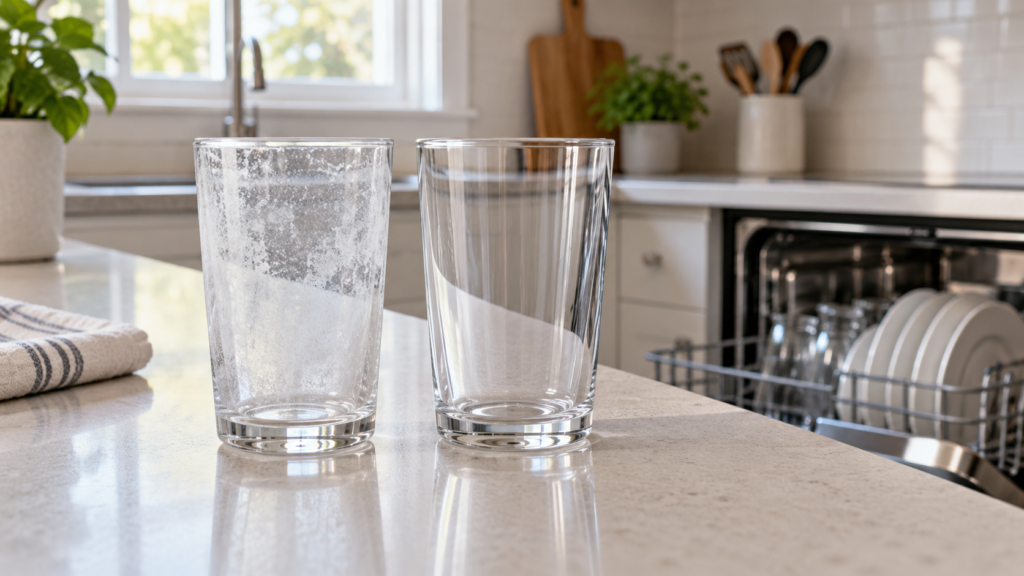
Hard-water film often looks chalky, cloudy, or spotty. It may appear on glasses, plates, flatware, and the dishwasher tub.
The U.S. Geological Survey explains that hard water contains dissolved minerals, largely calcium and magnesium. As water dries, those minerals can remain on glassware and other surfaces.
Mineral film may be more likely when:
- Faucets and shower doors also develop pale scale
- The dishwasher interior has a whitish coating
- The film dissolves when tested with white vinegar
- The problem becomes more noticeable after a change in water supply or softener settings
Detergent Residue
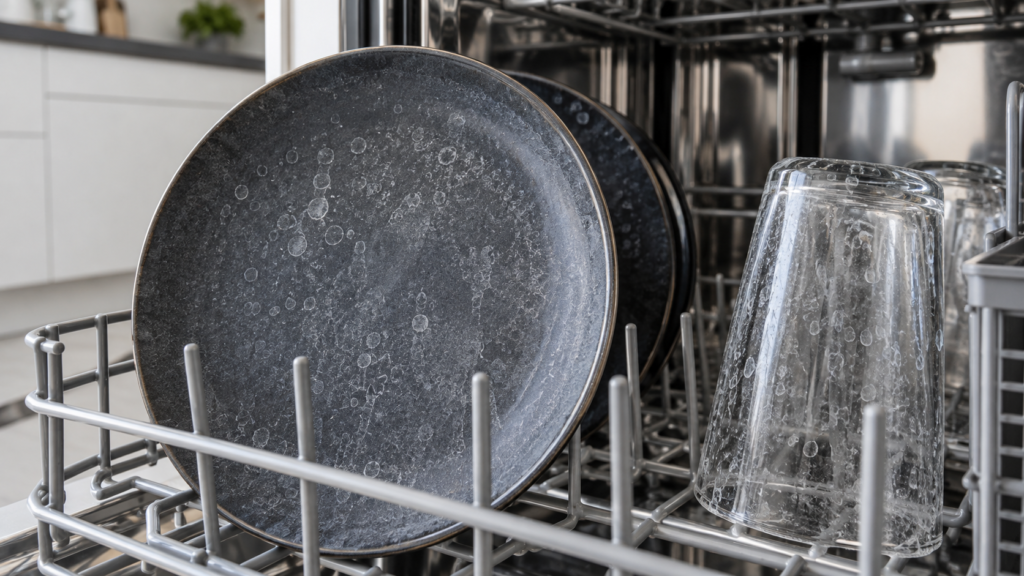
Detergent residue may look powdery, grainy, or uneven rather than uniformly cloudy. You might also find detergent remaining in or near the dispenser after a cycle.
Possible causes include:
- Using more detergent than the water conditions require
- A blocked detergent-dispenser door
- Damp or clumped powdered detergent
- Dishes preventing the spray from reaching the dispenser
- Poor water circulation or insufficient filling
- Using a cycle that does not match the load or detergent instructions
Use only detergent labeled for automatic dishwashers. Hand dishwashing liquid can produce excessive suds and should not be substituted.
Permanent Glass Etching
Etching is a physical change to the glass surface rather than a removable coating. It may appear as an even haze, fine scratches, or an iridescent cloudiness that does not wash away.
Dishwasher conditions that may contribute to etching include overly aggressive detergent use, very soft water, high-temperature washing, and repeated dishwasher cleaning of delicate glassware. Manufacturer guidance varies, so prevention should be based on the dishwasher manual and the glassware maker’s care instructions.
Do a One-Glass Vinegar Test
Test one ordinary glass outside the dishwasher before treating a full load.
Do not combine vinegar with dishwasher detergent, bleach, or another cleaning product. The CDC advises against mixing cleaning products or chemicals.
- Wash and rinse one affected glass with plain water.
- Apply a small amount of plain white vinegar to part of the cloudy surface using a soft cloth.
- Gently wipe the test area.
- Rinse the glass thoroughly and dry it with a clean towel.
- Compare the treated area with the untreated area.
If the test area becomes clear, mineral buildup is likely. Electrolux’s troubleshooting guidance uses the same distinction when separating limescale from other types of residue.
If plain water removes a loose, powdery coating, detergent residue is more likely.
If neither water nor vinegar changes the haze, the surface may be etched. This test is useful evidence, but it cannot identify every type of glass damage or residue.
Check Your Water Hardness
Find out whether your household water is hard before increasing detergent, changing rinse-aid settings, or using a descaling product.
Start with free information:
- Check your local water utility’s water-quality report
- Review the current setting on a household water softener, if present
- Ask a landlord or property manager whether the building uses softened water
- Look for a water-hardness value in the dishwasher manual or setup instructions
A national hardness map cannot determine the exact conditions at one home. The USGS recommends using local utility, health-agency, or water-softener information for household decisions.
If local information is unavailable, water-hardness test strips water hardness test strips can provide a basic household reading. Match the result to your dishwasher manual instead of using a universal detergent amount or hardness setting.
Recheck the Detergent
More detergent is not automatically better. The appropriate amount depends on the detergent formula, water hardness, soil level, cycle, and dishwasher design.
Check these points:
- Follow both the dishwasher manual and detergent label
- Confirm that the product is intended for automatic dishwashers
- Store powdered detergent where it stays dry
- Make sure the dispenser can open without hitting a plate, pan, or utensil
- Check for hardened detergent around the dispenser
- Do not place loose detergent in a location not approved by the manual
Unit-dose detergent is convenient but cannot be adjusted easily. If your home has very soft or mechanically softened water and film developed after switching detergent forms, consult the manual or detergent manufacturer rather than cutting open a packet.
Change only one detergent-related factor for the next test load. Simultaneously changing the dose, cycle, rinse aid, and loading pattern makes it difficult to identify the cause.
Check the Rinse Aid and Water-Softening Features
Rinse aid changes how water drains from dish surfaces during the final rinse and may reduce spotting and drying marks. If your manual permits it, an automatic dishwasher rinse aid automatic dishwasher rinse aid may help when droplets are drying on dishes.
Before adjusting the dispenser:
- Confirm that your model has an adjustable rinse-aid setting.
- Check whether the dispenser is empty or leaking.
- Use the starting setting specified in the manual.
- Change the setting gradually if the manufacturer provides that option.
Some dishwashers have a built-in water-softening system and a dishwasher-salt reservoir; many common U.S. models do not. If your machine has one, use only the type of salt and hardness setting specified for that model. Do not add table salt or dishwasher salt to a machine that was not designed for it.
Bosch’s white-film guidance also emphasizes matching water-softening and rinse-aid features to the appliance’s instructions.
Check Whether the Dishwasher Is Rinsing Properly
A water-chemistry adjustment will not solve residue caused by blocked spray, poor loading, or a dirty filtration area.
Check the Loading Pattern
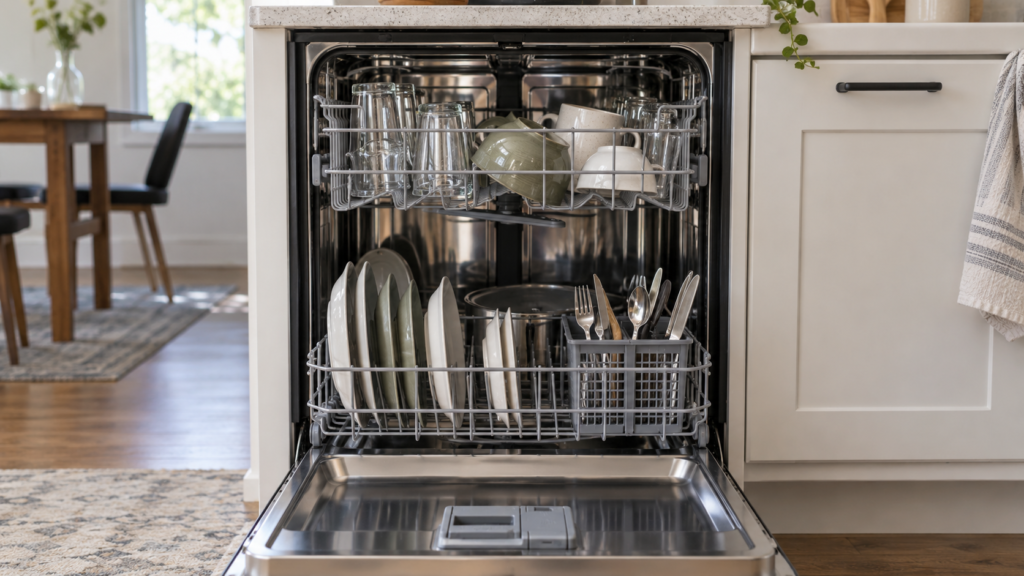
Before starting a cycle:
- Keep dishes from nesting tightly together
- Angle bowls and cups so water can drain
- Do not place tall items in front of the detergent dispenser
- Confirm that both spray arms can rotate without hitting dishes
- Keep lightweight items secured so they cannot flip over
- Avoid placing a large pan where it blocks spray from reaching the upper rack
Inspect the Filter and Spray Arms
Filter and spray-arm designs vary considerably. Some filters twist out by hand, while others require a model-specific procedure.
Turn the dishwasher off before reaching into the bottom of the tub. Wear gloves if broken glass may be present, and do not remove covers or components unless the manual identifies them as user-serviceable.
Following the manual:
- Check the removable filter for trapped food, labels, or glass
- Rinse a washable filter as directed
- Look for visible debris in spray-arm openings
- Confirm that installed spray arms rotate freely
- Reinstall every component securely before running the machine
Do not insert sharp metal objects into spray openings or reach into an unfamiliar pump area.
Run a Controlled Test Load
Once the basic checks are complete, test the dishwasher without adding several unapproved remedies.
- Load a small group of normally soiled, dishwasher-safe dishes.
- Include one clear glass that has not already been etched.
- Keep the dispenser and spray paths unobstructed.
- Use the detergent type and amount indicated for your water conditions.
- Add rinse aid only if the manual supports it.
- Select an appropriate normal cycle.
- Inspect the dishes in bright light when the cycle is complete.
If the result improves, repeat the same setup before changing anything else. If the film remains, adjust one factor—such as detergent amount or rinse-aid setting—for the next load.
Do not pour vinegar, bleach, dish soap, or multiple cleaning additives into the machine as an experiment. Use a dishwasher cleaning or descaling procedure only when it is approved for your model.
When the Cloudiness Will Not Come Off
Cloudiness that remains unchanged after careful washing and a vinegar spot test may be permanent etching.
An etched surface generally cannot be restored by further cleaning. Repeatedly treating it with stronger acids or abrasive powders may cause additional damage.
For future loads:
- Hand-wash delicate, decorative, antique, or manufacturer-excluded glassware
- Check whether the dishwasher has a glass or delicate cycle
- Match detergent use to softened-water conditions
- Avoid changing the household water temperature solely to correct cloudy glassware
- Follow care instructions for valuable glassware
When to Stop Troubleshooting
Stop using the dishwasher and arrange qualified service if you notice:
- Water leaking onto the floor
- A burning smell, smoke, or damaged wiring
- A breaker that repeatedly trips
- The machine failing to fill or drain
- Standing water combined with an error code
- Unusual grinding or electrical sounds
- A damaged hose, door seal, or tub
- A filter, pump cover, or spray assembly that cannot be safely removed as described in the manual
If moisture is coming from the plumbing connections in the sink cabinet, use the inspection steps in How to Prevent Moisture and Small Leaks Under the Kitchen Sink to determine whether the area needs immediate attention.
Renters should report leaks and suspected appliance failures to the landlord or property manager before disassembling plumbing or built-in appliance components.
Frequently Asked Questions
Q. Is hard-water film on dishes dangerous?
Hard-water minerals are generally considered a nuisance rather than a health concern. However, rinse any visible coating from dishes before use if you cannot determine whether it is mineral scale, detergent, or food residue.
Q. Can I pour vinegar directly into my dishwasher?
Only use vinegar inside the machine if the dishwasher manufacturer specifically permits that procedure. A one-glass test outside the dishwasher is a safer first diagnostic step. Never combine vinegar with bleach or another cleaning product.
Q. Why is the film more noticeable on plastic items?
Water often dries differently on plastic than on glass or ceramic. Droplets that remain on the surface can leave visible mineral spots. Loading plastic items so they can drain and using an approved rinse-aid setting may help.
Conclusion
A dishwasher leaving white film on dishes does not automatically need repair. First determine whether the coating is removable mineral film, detergent residue, or permanent etching. Then match one careful adjustment to the evidence you found instead of changing every setting or adding several cleaning products at once.