As an Amazon Associate I earn from qualifying purchases.
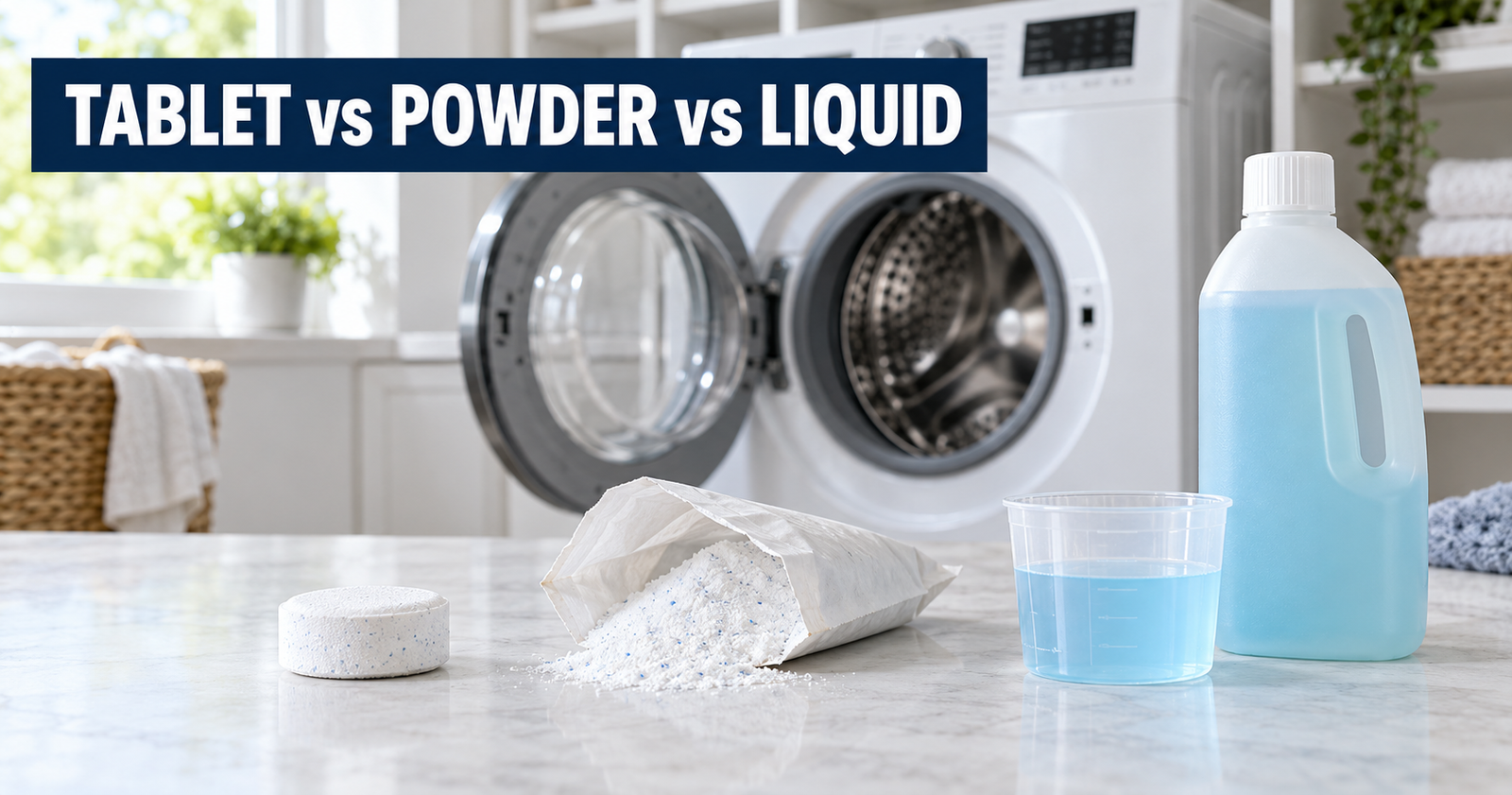
Washing machine cleaner tablets, powder, and liquid can all be useful, but the format alone does not determine how well a cleaner will work. Start by checking your washer’s manual. Some cleaning cycles are designed to run without any added cleaner, while other machines allow a commercial product.
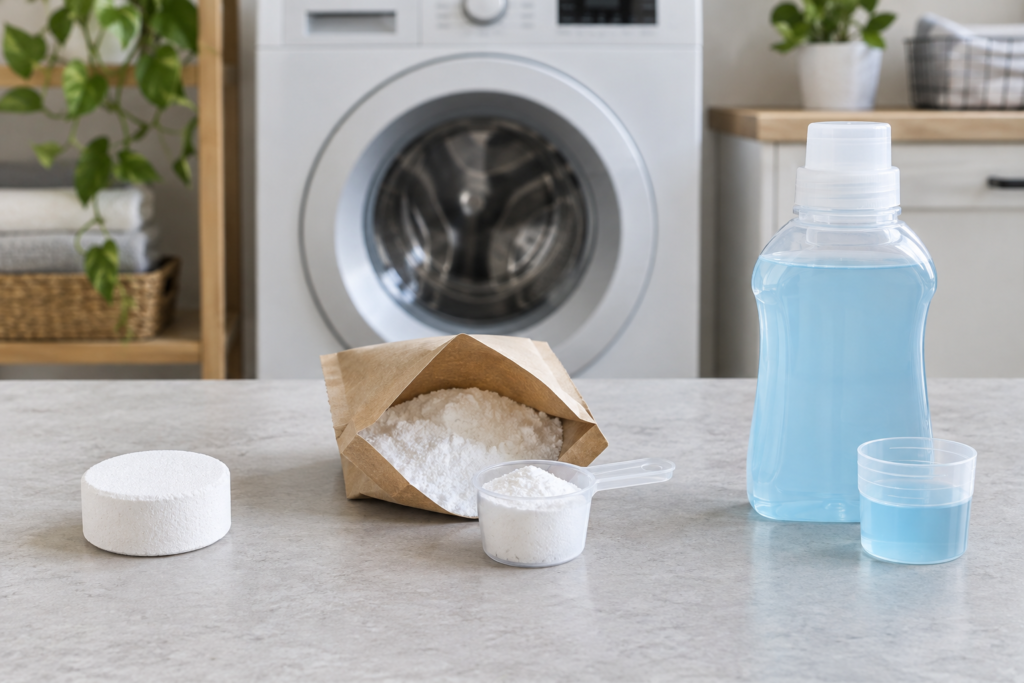
If your washer permits one, choose according to convenience, dosing, storage, and the cleaner’s stated purpose. Tablets are often the simplest premeasured option, powder may come in packets or a loose formula, and liquid is easy to pour but may require more careful measuring.
The Short Answer: Compatibility Matters More Than Form
Before comparing formats, confirm that your washer should be used with a cleaner at all.
For example, current manufacturer guidance for certain Self Clean cycles says to run the cycle with an empty washer and no added cleaner. Other manufacturers and cleaner labels provide different directions. Your model’s instructions take priority over general online advice.
Check these four points before buying:
- Is the product labeled for your washer type?
- Does your manual allow a commercial washer cleaner?
- Does the product go in the drum or a dispenser?
- Is it intended for odor-causing residue, mineral deposits, or general maintenance?
Do not assume that a tablet, powder, or liquid automatically handles every type of buildup.
Compare Tablets, Powder, and Liquid
Tablets: Convenient and Premeasured
Tablets are usually packaged as single doses, so there is no powder to scoop or liquid to measure. They are also compact and easy to store as long as the container remains dry and securely closed.
The main limitation is that you cannot adjust the amount unless the product label specifically provides different directions. Any material remaining after the cleaning cycle should be removed according to the product and washer instructions.
If your washer allows a commercial cleaner and you prefer one premeasured piece, washing machine cleaner tablets washing machine cleaner tablets may be the simplest format to handle.
Do not automatically put a tablet in the detergent dispenser. Some official tablet directions specify placing it directly in the empty drum.
Powder: Packets or Loose Product
Powder cleaner may be sold in individual packets or a larger container. A packet provides a premeasured dose similar to a tablet, while a loose powder requires careful measuring.
Powder must be protected from moisture during storage. It may clump if the package is left open or stored in a damp laundry area. More powder is not necessarily more effective, so use only the labeled amount.
If you prefer individual sachets or a loose formula, powder washing machine cleaner provides those options.
Some official powder-cleaner directions instruct users to empty the washer and pour one packet into the drum. That instruction applies to that formula, not to every powder product.
Liquid: Pourable but Easy to Overmeasure
Liquid cleaner does not require a solid tablet or powder to disperse, but that does not make it automatically stronger or more compatible with a particular washer.
Some liquid products come in a single-use amount, while others require measuring. If measurement is required, use the supplied cap or the method specified on the label. Avoid estimating the amount by eye.
If the product label and washer manual permit it, liquid washing machine cleaner may suit readers who prefer a pourable product.
Store liquid upright in its original container. Do not assume it belongs in the detergent drawer merely because ordinary liquid detergent goes there. Cleaner placement varies by formula.
What to Check Before You Buy
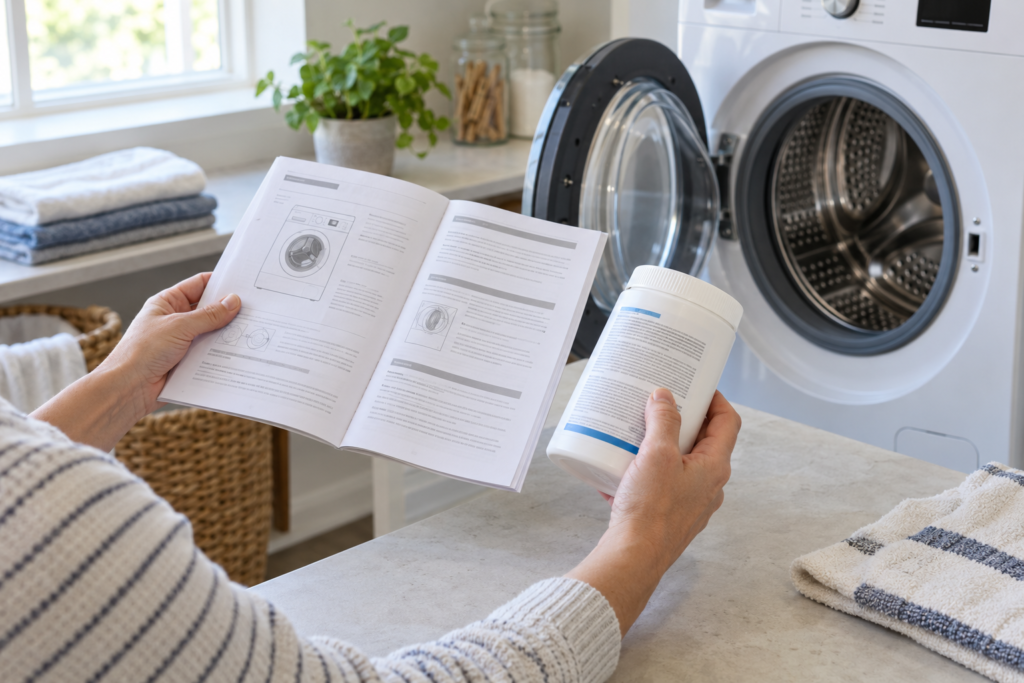
Check the Washer Manual
Look for a section named Tub Clean, Clean Washer, Self Clean, Pure Cycle, or Maintenance. The manual should indicate:
- Whether a cleaner is needed
- Which types are permitted
- Which cycle to select
- Whether the machine should be completely empty
- Whether the product goes in the drum or a dispenser
If the printed manual is missing, search the manufacturer’s support site using the complete model number. The model number is commonly found around the door opening, beneath the lid, or on a label at the back, depending on the washer.
Read the Cleaner Label, Not Just the Front Package
Two cleaners in the same format may have different formulas and directions. Read the full label for:
- Compatible machine types
- Correct dose
- Required water temperature or cycle
- Drum or dispenser placement
- Ventilation and handling precautions
- Instructions for any residue left after the cycle
A cleaner labeled for both standard and high-efficiency washers may still have specific placement instructions.
Match the Product to the Problem
Decide what you are trying to correct before choosing a cleaner.
A general maintenance cleaner may address detergent and odor-causing residue. A product marketed for mineral deposits may have a different purpose. Do not assume that either one will remove visible mold from a gasket or repair a drainage problem.
A cleaner also cannot correct a damaged door seal, clogged pump filter, slow drain, or sewer odor entering through the plumbing.
Consider Fragrance and Storage
Check whether the product is scented if anyone in the home is sensitive to fragrance. “Fresh” or “clean” scent is not evidence that the washer itself is clean.
Choose packaging that can be stored securely away from children and pets. Tablets and powder must remain dry, while liquids should remain upright in their original containers. Never transfer washer cleaner to an unlabeled food or drink container.
How to Use Washing Machine Cleaner Safely
Before the Cycle
Use the washer manual and the cleaner label together. When the two instructions conflict, contact the washer manufacturer before proceeding.
Before starting:
- Remove all clothing and other items from the washer.
- Check that no small items remain in the drum or gasket.
- Add only the labeled amount of one approved cleaner.
- Place it exactly where the product directions specify.
- Select the cleaning cycle recommended by the washer manufacturer.
- Keep children and pets away from the open product and appliance.
Never combine washer cleaner with bleach, ammonia, vinegar, detergent, or another cleaning product. The CDC warns against mixing bleach or disinfectants with other cleaners because dangerous vapors can result. Using one approved cleaning method per cycle also prevents untested chemical combinations.
After the Cycle
Inspect the empty drum when the cycle finishes. If the product instructions call for wiping away residue, use a clean cloth and include the drum opening, door glass, and accessible gasket surfaces.
A cleaning cycle does not necessarily clean every removable or concealed area. Depending on the washer design, the detergent drawer, door gasket, drain-pump filter, or lint filter may require separate maintenance described in the owner’s manual.
Allow accessible surfaces to dry. Leave the door or lid and dispenser drawer open only when the manufacturer permits it and doing so will not create a hazard for children or pets.
If you prefer grouping appliance care into a broader routine, add these checks to a seasonal home maintenance checklist.
When a Cleaner Is Not the Whole Fix
Stop repeating cleaning cycles if the underlying problem remains unchanged. More cleaner can create additional residue without correcting the cause.
Check the manual or arrange service if you notice:
- Water leaking onto the floor
- A burning or electrical odor
- Smoke, sparking, or unusual heat
- A washer that will not drain
- Persistent sewer-like odor
- A damaged or heavily contaminated door gasket
- Error codes that return after the recommended maintenance
- Cleaner residue that remains after the label’s rinse instructions
- Odor that appears only while the machine is draining
Visible debris in an accessible gasket or dispenser may require careful manual cleaning. A clogged filter or drainage problem requires model-specific instructions. Do not disassemble sealed panels, electrical components, or unfamiliar plumbing connections simply to reach suspected buildup.
Frequently Asked Questions
Q. Can I use more cleaner when the washer smells particularly bad?
No. Use the amount on the cleaner label. A stronger odor does not make an extra dose safer or more effective. Instead, inspect the gasket, dispenser, filter, and drain areas identified in the washer manual.
Q. Can a tablet or powder go in the detergent dispenser?
Only when that specific product’s directions say so. Many cleaner products are placed directly in an empty drum, but instructions vary. Do not copy the placement instructions from another brand or format.
Q. Do I need cleaner every time I run the washer’s cleaning cycle?
Not necessarily. Some manufacturers specify that their cleaning cycle should run without an added product. Follow the schedule and method in the manual for your exact model rather than using a universal routine.
Q. Is one form safer for a septic system?
The physical format alone does not determine septic compatibility. Look for a specific statement on the product label and follow the labeled amount. If your septic system has special restrictions, check with the system manufacturer or service provider.
Q. Does washer cleaner replace cleaning the gasket and dispenser?
No. A cleaning cycle may help with residue inside the tub, but accessible gasket folds, dispenser parts, and filters may still need separate cleaning. Follow the model-specific removal and cleaning instructions.
Conclusion
Choose a washing machine cleaner only after confirming that your washer allows one. Tablets favor simple premeasured use, powder offers packet or loose options, and liquid provides a pourable format—but the washer manual, cleaner label, correct dose, and intended purpose matter more than the form.