As an Amazon Associate, I earn from qualifying purchases. This costs you nothing extra.
I have a French door refrigerator with the freezer in a pull-out drawer at the bottom. On paper, it’s the better layout: the fridge section sits at eye level, so the food you reach for ten times a day is right there. That part is genuinely great.
The freezer is a different story.
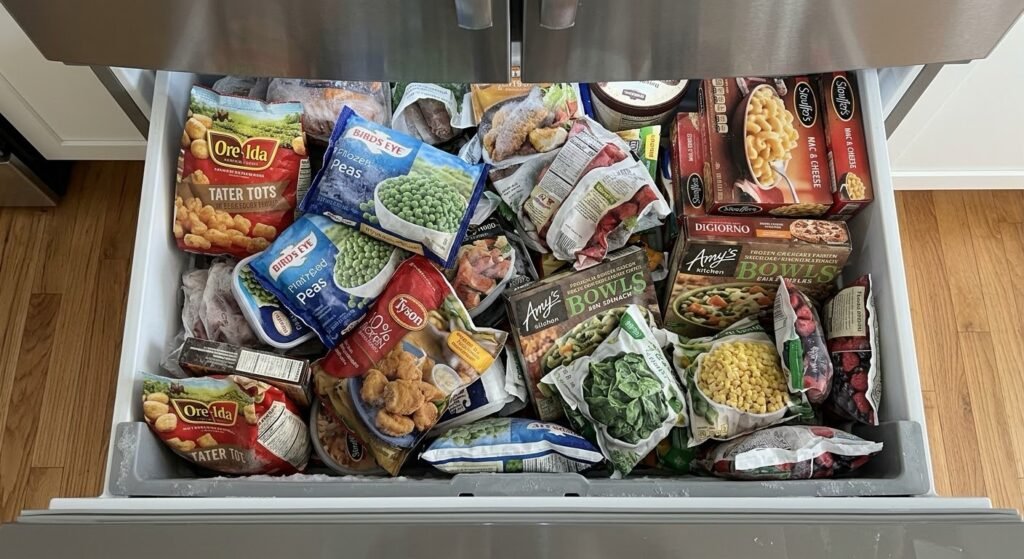
For about a year, opening that drawer meant staring down into a jumbled pile of frozen bags and boxes and hoping the thing I wanted was somewhere near the top. It usually wasn’t. I’d find chicken I bought in spring sitting under a bag of peas in August, wearing a thick coat of freezer burn. I bought duplicates of things I already owned because I couldn’t see them.
If that sounds familiar, it’s not a discipline problem. It’s a design problem — and once I understood why the drawer fails, fixing it took one afternoon and about forty dollars.
Why bottom freezer drawers get messy so fast
1. You look down into it, not at it
An upright freezer is a wall of shelves. You scan it the way you scan a bookshelf — everything faces you. A drawer is a pit. You see only the top layer, and whatever is underneath effectively stops existing.
2. There are almost no shelves
Most bottom drawers give you one deep basin and maybe one shallow sliding tray. That’s it. There’s nothing built in to stop food from stacking into one compacted mass.
3. Everything shifts every time you open it
A drawer moves. Every open-and-close slides the contents forward and back, so whatever neat arrangement you made on Sunday is scrambled by Wednesday.
4. First-in, first-out breaks completely
New groceries go on top. Old food sinks. That’s the exact opposite of how you want to eat through a freezer, and it’s the main reason food gets wasted down there.
5. Frost finds the forgotten stuff
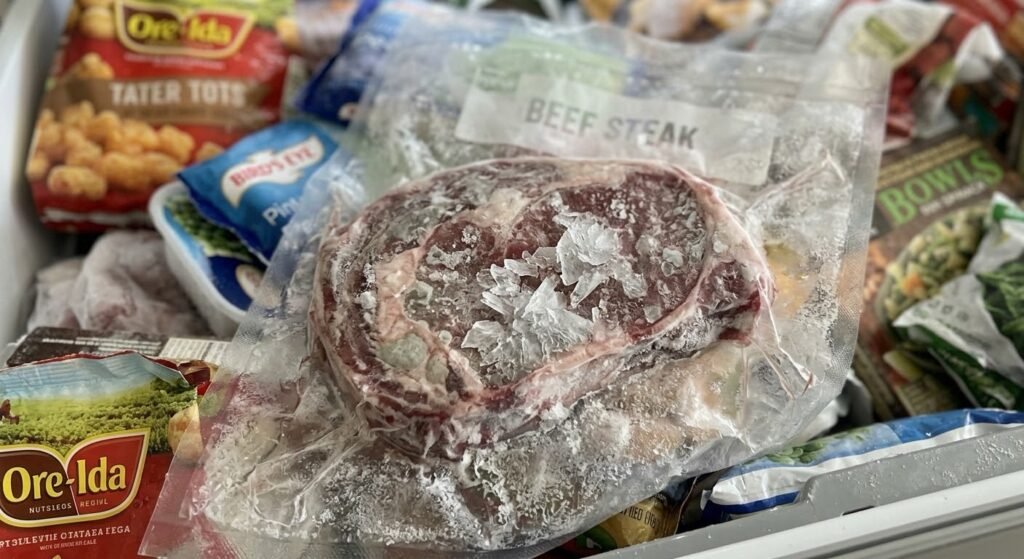
Items buried at the bottom sit undisturbed for months, and that’s where freezer burn shows up first — dry gray patches on meat, ice crystals inside bags.
What didn’t work for me
Before I landed on a system, I wasted time on a few things:
Just stacking neatly. I’d reorganize everything into tidy layers, feel great about it, and watch it collapse within three days. Neatness without structure doesn’t survive a drawer.
Flat-laying bags with no dividers. Freezing food flat is a good idea — but if you just lay flat bags on top of each other, you get a slippery stack that avalanches the moment you pull something from the middle.
Buying bins before measuring. My first set of organizers was too tall. The drawer wouldn’t close all the way, and the door seal kept popping. I had to return all of them.
That last one is worth repeating: measure the drawer before you buy anything.
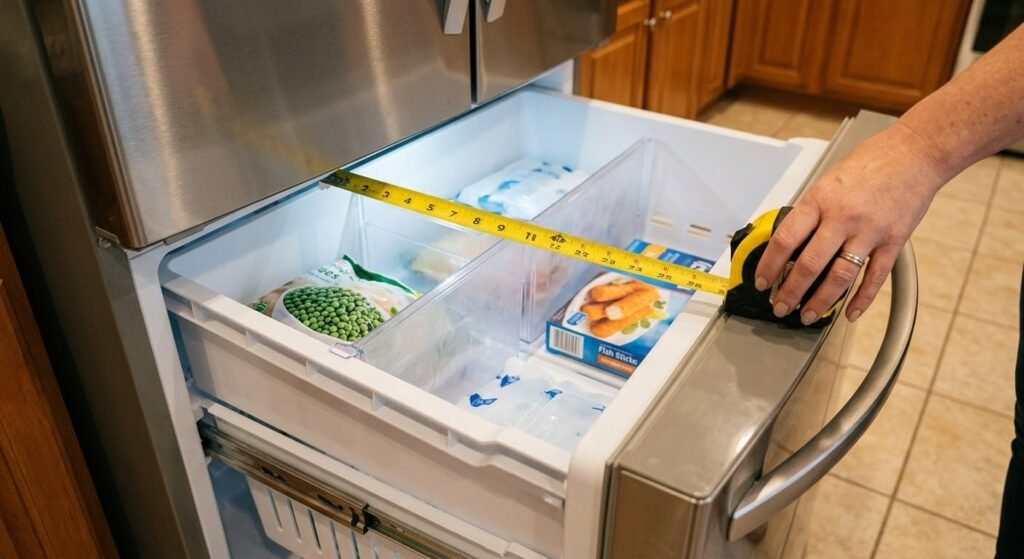
Measure first (this takes two minutes)
Pull the drawer all the way out and write down:
- Interior width — inside wall to inside wall
- Interior depth — front to back
- Usable height — from the floor of the basin to the underside of the fridge above it, not to the top edge of the drawer. This is where most people get it wrong.
- Obstructions — the ice maker arm, a sliding upper tray, or a raised section over the drawer rails
Then aim for bins that leave about an inch of clearance at the top. You want to be able to drop things in without wedging them.
The setup that finally worked
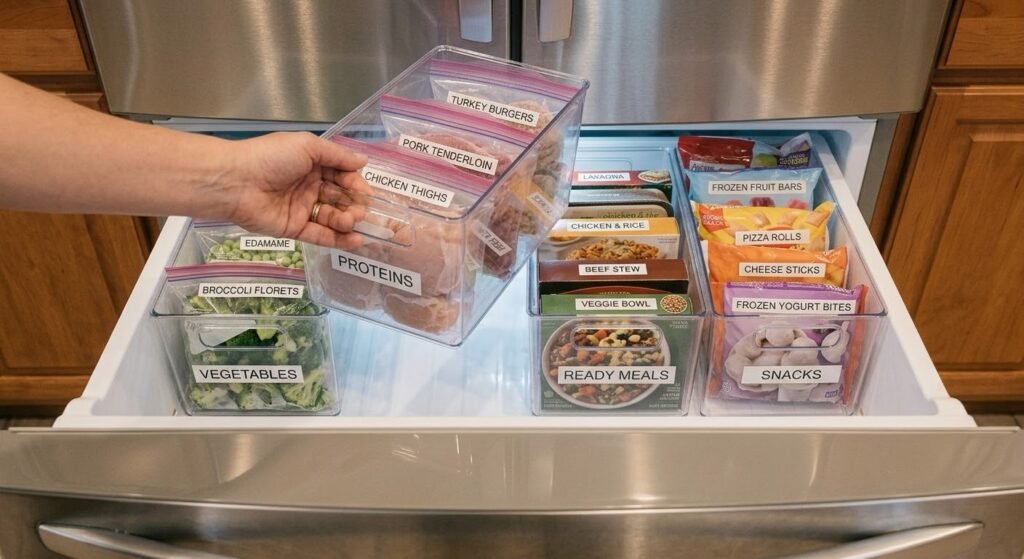
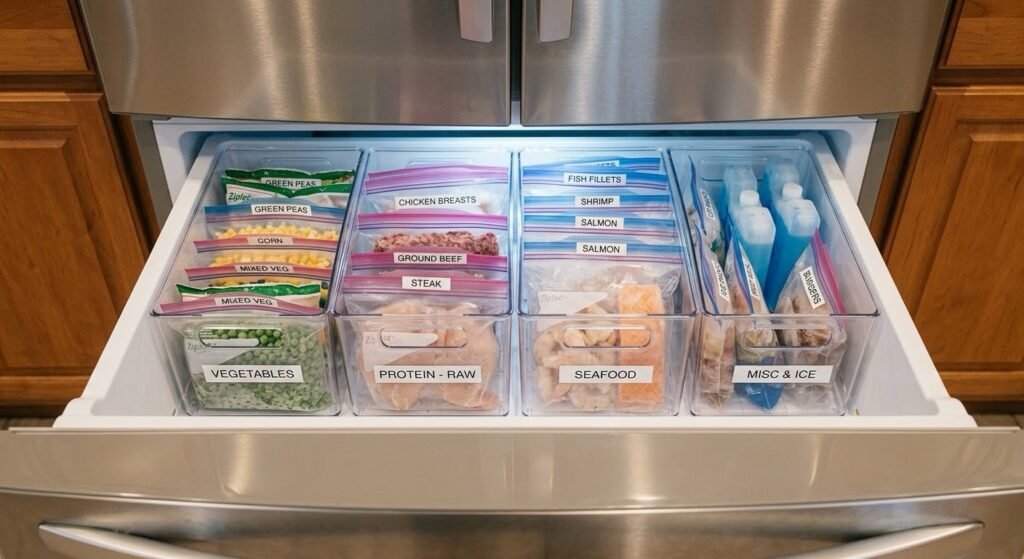
The core idea: stop stacking horizontally, start filing vertically. Everything stands upright like folders in a filing cabinet, so you can see every item from above at once.
Here’s what I use.
Clear stackable freezer bins with handles
These are the backbone of the whole system. Clear so you can identify contents at a glance, handled so you can lift a whole category out instead of digging through it.
I use four of them, each one a category. When I want chicken, I lift out the protein bin, take what I need, and drop it back. I never dig anymore.
What to look for: BPA-free plastic rated for freezer temperatures (cheap plastic gets brittle and cracks in the cold), built-in handles, and a footprint that tiles neatly into your measured drawer.
Clear stackable freezer storage bins with handles
Reusable flat-freeze bags
This is the piece that makes vertical filing possible. Anything soft — ground meat, soup, berries, sauce, leftover rice — gets pressed flat in a bag and frozen on a sheet pan for an hour before it goes in the drawer.
Flat bags stand upright in a bin. Lumpy bags don’t. That’s the whole trick.
Silicone reusable bags cost more up front but pay for themselves and freeze flatter than most disposables.
Reusable silicone freezer bags
A shallow second-tier tray
If your drawer has vertical room to spare above the bins, a shallow tray across the top holds the small stuff that gets lost otherwise: ice packs, single portions, that half-bag of shredded cheese.
Labels and a freezer marker
Unglamorous, but this is what keeps the system honest. Every bag gets what it is and the date it went in. A regular marker smears and fades in the cold; get one made for freezer use, or use write-on freezer labels.
How I zone the drawer
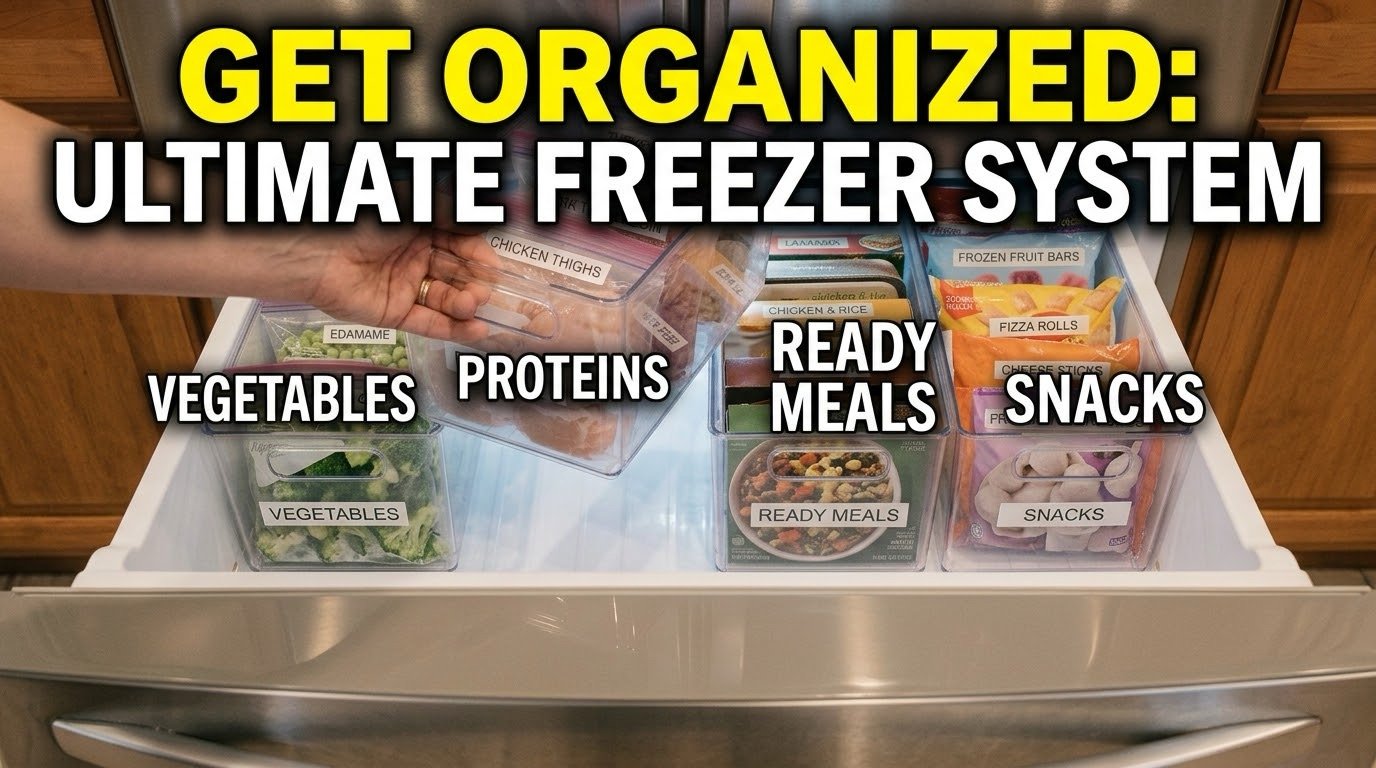
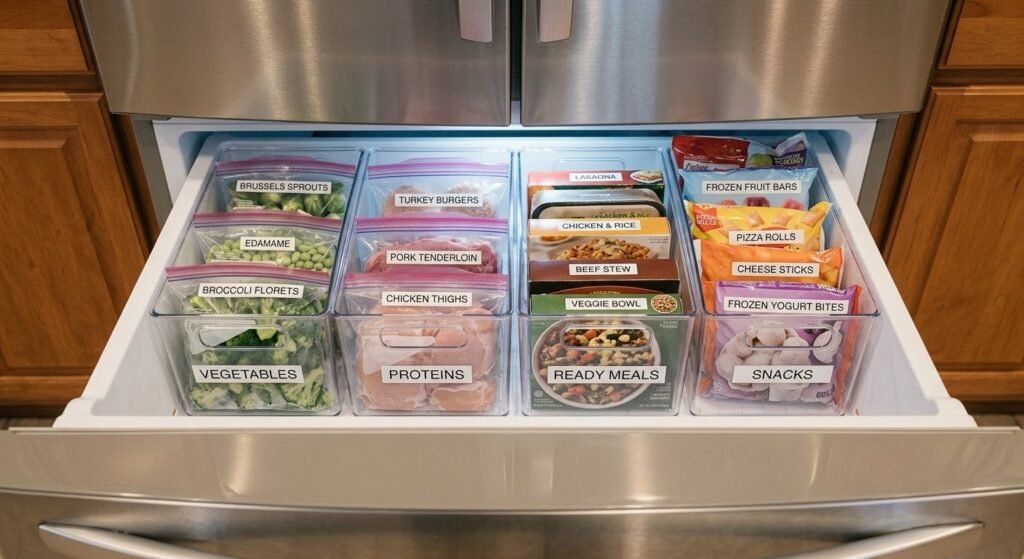
Four bins, four categories. Yours may differ, but keep the number small — too many categories and you’ll stop putting things back correctly. Bin What goes in it Proteins Chicken, beef, fish, ground meat — all flat-frozen Vegetables & fruit Frozen veg bags, berries, smoothie portions Ready meals Soups, leftovers, batch-cooked portions Snacks & odds Ice cream, waffles, bread, ice packs
I keep the two bins I reach for most at the front of the drawer, and I rotate them every couple of months as habits change.
Three habits that keep it from sliding back
Date everything, no exceptions. A bag without a date becomes a bag you’re afraid of, and a bag you’re afraid of becomes a bag you throw away.
Run an “eat down” week once a month. Pick one bin and cook from it before buying anything new for that category. This is the only real defense against the sinking-to-the-bottom problem.
Never fill above the bin rim. The moment food stacks above the bins, you’re back to a pile. If it doesn’t fit in a bin, it doesn’t go in the freezer that week.
Frequently asked questions
Q. Do bins reduce my freezer capacity?
A. Slightly — you lose the volume of the plastic walls themselves. But in practice you’ll store more usable food, because vertical filing packs far more efficiently than a random pile, and you stop losing items to freezer burn.
Q. Clear bins or opaque?
A. Clear, every time. The entire problem with a bottom drawer is that you can’t see what’s in it. Opaque bins just move the black hole one level up.
Q. Will any plastic bin work?
A. No. Bins not rated for freezer temperatures get brittle and crack — usually right at the handle, usually while it’s full. Check that the listing specifically says freezer-safe.
Q. What about the sliding tray my freezer came with?
A. Keep it, and use it for flat, frequently-grabbed items — waffles, pizza, ice packs. Just make sure it still slides freely once your bins are in place underneath.
Q. How do I stop frost from building up?
A. Press the air out of bags before sealing, don’t leave the drawer open while you decide what to cook, and let hot food cool completely before freezing it. Most frost is just moisture you brought in yourself.
The bottom line
A bottom-drawer freezer isn’t badly designed — it’s just designed to be looked at from above, and almost nobody stores food that way by default. Once I switched from stacking to filing, the drawer stopped being a place where groceries went to disappear.
The fix is genuinely small: measure the drawer, buy four clear freezer-safe bins with handles, freeze soft food flat so it stands up, and label everything with a date. That’s the whole system.
If your freezer drawer currently makes you sigh when you open it, start with the measuring tape. Everything else follows from that.
If excess moisture is appearing elsewhere in the refrigerator, this guide to preventing condensation in the crisper drawer explains how humidity settings and airflow affect the problem.