
Water marks on a lampshade almost never come from using too much water. They come from using it in one place. When you dampen a single spot, the moisture carries dissolved dust toward the edge of the wet area and leaves it there as the fabric dries — a faint tide line that’s often more visible than the stain you were trying to remove. The rule that prevents it is simple: either work the entire surface evenly, or don’t use water at all.
Which of those two you choose depends on one thing, and it’s worth checking before you touch the shade with anything damp.

First, Find Out How the Shade Is Built
Lampshades are attached to their frame in one of two ways, and the difference decides everything that follows.
Look closely at the top and bottom rims, and at the vertical seam. If you can see stitching, the fabric is sewn to the frame. If the edges look smooth and sealed with no thread visible, it’s glued — which is the more common construction on modern shades.
Lampshade makers are consistent on this point: shades assembled with glue should not be submerged, because water softens the adhesive and the fabric can separate from the frame or the trim can lift. Sewn shades can generally handle immersion. If you genuinely can’t tell, treat it as glued.
Two other things matter before you start. Take the shade off the lamp entirely — water near a socket is a shock risk, and cleaning solution can damage the lamp’s finish. And handle the shade by its frame or fitting rather than the fabric panel, since pressing on the fabric dents and creases it.
Why the Tide Line Forms
Understanding this makes the rest of the article make sense.
Fabric shades hold a fine layer of airborne dust, cooking film, and smoke residue. When you wet part of the shade, that residue dissolves and travels outward with the water. As the damp area shrinks during drying, everything it carried gets deposited at the boundary. That’s your ring.
It’s the same reason a coffee spill leaves a dark outline rather than an even stain. The edge is where the water stops moving.
So spot cleaning is the method most likely to cause the exact problem people are trying to fix. If you must clean a limited area, you have to feather the damp cloth outward well past the mark so there’s no hard boundary where drying stops.
Start Dry, and You May Not Need Water at All
Most lampshades that look dingy are only dusty. Working dry first removes the majority of it and often ends the job before any risk of marking begins.
- Lift the loose dust. A lint roller works well on smooth cotton and linen. Roll gently — on thin or aged fabric the adhesive can pull at fibers. For pleated or textured shades, a soft brush attachment on a vacuum at low suction is safer than anything sticky.
- Do the inside too. The interior collects more than people expect, especially on shades over bulbs that run warm. Dust there is what gives a shade that yellowed look when the lamp is on.
- Try a dry cleaning sponge on marks. A dry rubber sponge lifts smoke film, soot, and general grime with no moisture at all. Wipe in one direction across the whole panel rather than scrubbing at one spot.
Finish by wiping the frame and the bulb with a dry cloth. A dusty bulb makes a clean shade look grey again the moment you switch it on.
If the Shade Is Sewn: The Full Immersion Method
This is the approach that avoids water marks entirely, because there’s no boundary between wet and dry.
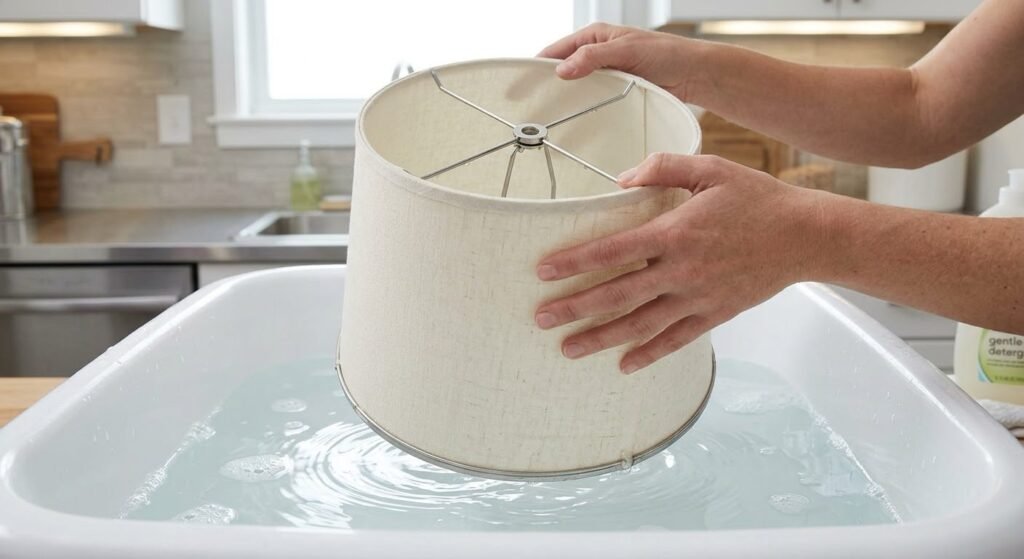
Fill a bathtub or a large container with lukewarm water — deep enough to cover the shade completely. Add a small amount of gentle detergent. Use less than feels right; heavy suds are difficult to rinse out and leave their own residue.
Hold the shade by the frame and lower it in. Wipe the fabric with a soft sponge using straight up-and-down strokes rather than circles. For a stubborn area, dab with a soft brush instead of rubbing, since rubbing can move dye and leave a lighter patch. Change the water if it turns cloudy.
Rinse by dipping the shade in and out of clean water until no soap remains. Then move straight to drying — a wet shade sitting still is where the next set of problems starts.
If the Shade Is Glued: Damp Cloth, Whole Surface
Glued shades can still be cleaned. They just can’t be soaked.
Mix a little mild detergent into cool water. Dip a microfiber cloth and wring it out until it’s barely damp — damp enough to lift dirt, not wet enough to leave the fabric saturated.
Work the entire panel, not just the dirty part. On a pleated shade, run the cloth along each pleat from the top rim to the bottom rim in one continuous pass. Pooky, a lampshade maker, gives exactly this advice for pleated shades, noting it prevents both watermarks and the equally obvious problem of a suspiciously clean patch surrounded by a dingy shade.
Then go over the same surface with a second cloth dampened in plain water to lift the detergent, and follow with a dry cloth to pull out as much moisture as possible.
Whatever cleaner you use, test it somewhere hidden first — the inside of the bottom rim works well. Some sprays discolor pale fabric, and you’d rather find out on a patch nobody sees.
Drying Is Where Shades Get Ruined
More damage happens during drying than during washing.
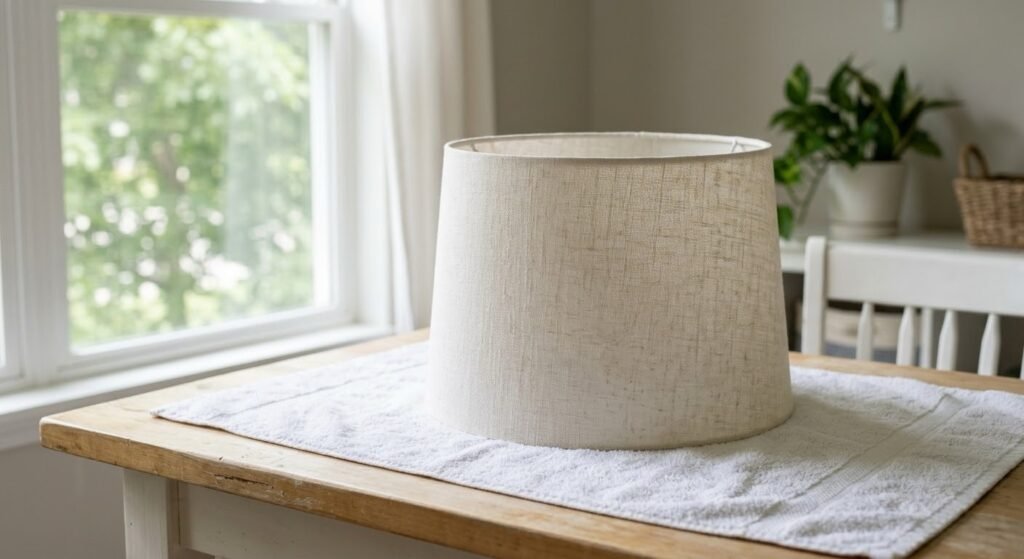
Air dry the shade in a well-ventilated spot, away from direct sunlight and away from heat sources. Heat can shrink the fabric on the frame; sunlight fades it unevenly, which is its own kind of permanent mark.
Set it on a clean dry towel and turn it occasionally so no single area stays in contact with damp fabric. Metal frames on older shades can leave rust marks if the fabric stays wet against them, so the faster and more evenly it dries, the better.
Do not put the shade back on the lamp until it’s completely dry, inside and out. A shade that’s dry to the touch on the surface can still be holding moisture in the seams and rim binding.
What Not to Do
- Don’t put a lampshade in the washing machine unless the maker’s own care label specifically says the shade is machine washable. Some newer washable shades are designed for it; most shades are not, and the frame will not survive the drum.
- Don’t use bleach on colored fabric. It removes color unevenly, and uneven color removal is exactly the outcome you’re trying to avoid.
- Don’t attack one stain with a wet cloth. This is the single most common cause of the water mark people then search for how to remove.
- Don’t use a hair dryer to speed things up. Concentrated heat in one spot shrinks fabric unevenly and can loosen adhesive on glued shades.
When to Leave It to a Professional
Some shades aren’t worth the risk of a home attempt. Lampshade specialists commonly recommend professional cleaning for silk shades, hand-embroidered or heavily beaded shades, painted shades, and antique pieces. Silk in particular does not tolerate submersion, and the fabric on older shades can be brittle enough to tear under a lint roller.
If the shade has visible mildew rather than dust — grey or black speckling that doesn’t lift when dry-cleaned — that’s also a reasonable point to stop. Mildew on fabric is frequently deeper than the surface, and the bleaching agents that remove it will take the color with them on anything that isn’t white.
Frequently Asked Questions
Q. I already have a water ring on my shade. Can I fix it?
A. Sometimes, and the method is counterintuitive: rather than treating the ring, you re-wet the entire panel evenly so there’s no longer a boundary for the residue to settle at, then dry it evenly. This works on sewn shades that tolerate immersion. On a glued shade the safer version is a barely damp cloth worked across the whole surface. Neither is guaranteed, especially if the mark has been there a long time.
Q. How can I tell if my shade is glued or sewn?
A. Look at the top and bottom rims and the vertical seam under good light. Visible stitching means sewn. A smooth, sealed edge with no thread means glued. When it isn’t clear, assume glued and use the damp cloth method instead of immersion.
Q. Can I use a magic eraser on a fabric shade?
A. It’s abrasive, which is a poor match for woven fabric — it can fuzz the surface and leave a patch that catches light differently than the area around it. A dry cleaning sponge is the gentler tool for the same job.
Q. How often should lampshades be cleaned?
A. A quick dry dusting every week or two prevents almost all of the buildup that leads to a deep clean being necessary. Shades in kitchens and near candles or fireplaces collect film faster and benefit from more frequent attention.
Conclusion
The whole problem comes down to boundaries. A water mark is just the edge of where a damp area stopped. Dust the shade dry first, check whether it’s glued or sewn before anything gets wet, and if you do use water, commit to the entire surface rather than one spot. That single habit prevents the mark you’d otherwise be searching for a way to remove.
If the mark is on washable clothing rather than a lampshade, this guide to removing common clothing stains covers fabric-specific treatment methods.