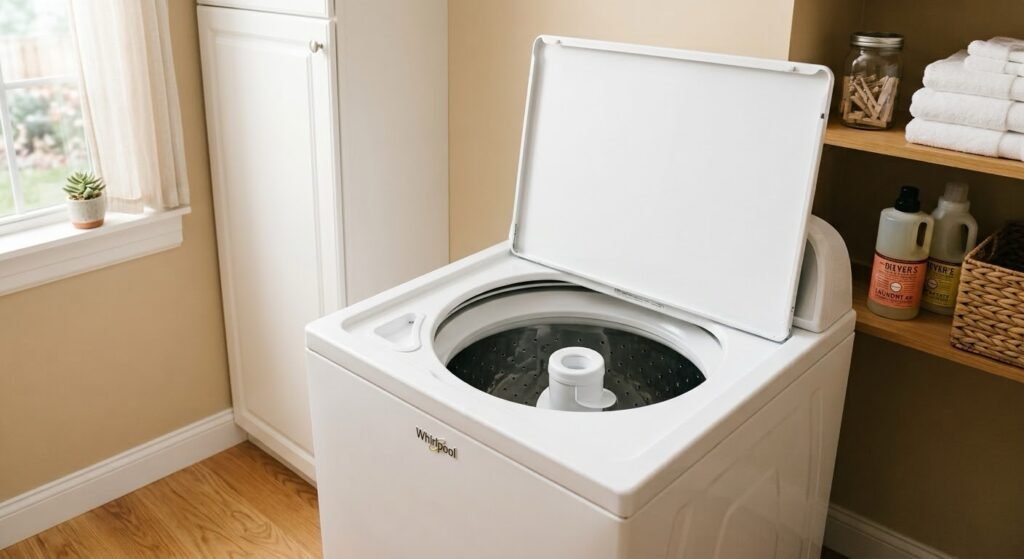
If your top-load washer smells damp no matter how often you clean it, the cleaner probably isn’t the missing piece. The lid is. Every wash leaves a small amount of water sitting around the agitator, inside the dispenser, and along the rim of the opening. Close the lid on that and the moisture has nowhere to go. Leave it open and most of it is gone on its own.
That one habit does more than any product on the shelf. Here’s what’s actually happening inside the machine, and what to check if the smell keeps coming back anyway.
The Moisture Doesn’t Leave on Its Own
Front-load washers get most of the blame for mildew because of their rubber door gasket. That leads a lot of people to assume top-loaders are safe. They aren’t — they just hide it in different places.
A top-loader holds water in four spots you don’t usually think about: the seal around the lid opening, the detergent and fabric softener dispenser shaft, the base of the agitator, and the drain hose. None of these dry out quickly with the lid shut. What builds up in them is biofilm — a thin layer of soap scum, softener residue, and bacteria that forms anywhere moisture sits without airflow. It’s not exotic. It’s ordinary bacteria from your laundry, given somewhere warm and wet to settle.
Cooler wash cycles make it easier for that layer to survive, which is part of why the problem shows up more in machines that mostly run cold.
I mostly noticed it when moving a load over to the dryer — that’s when the smell would hit me. I assumed at first it was just from letting the wash sit too long before I got to it. Once I started leaving the lid open, though, the difference was obvious. Even on the days I didn’t get to the load right away, there was clearly less odor than before.
Where the Smell Actually Lives
Running a cleaning cycle handles the drum. It doesn’t reach the three places that cause most repeat complaints.
The Dispenser
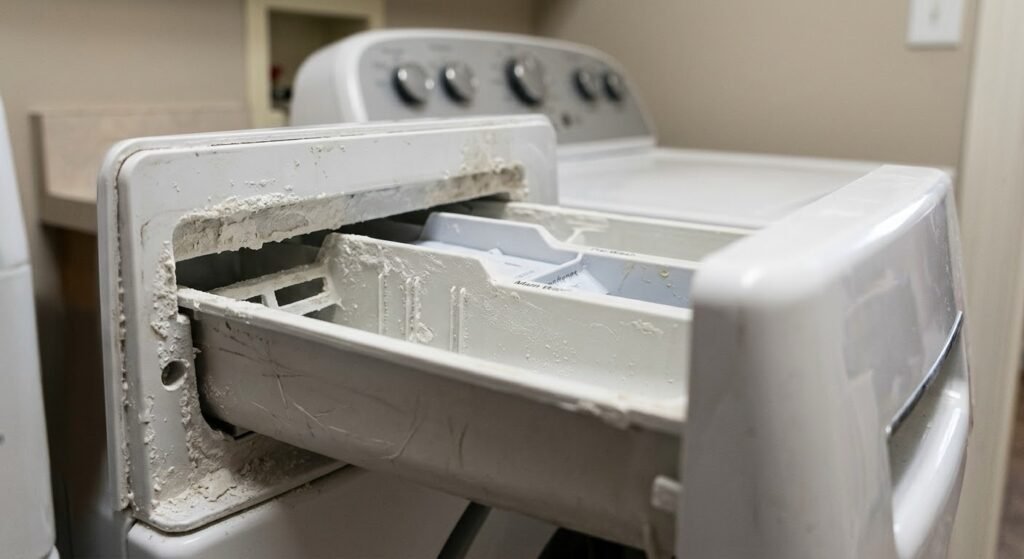
Undissolved powder and fabric softener collect in the drawer or the shaft below it, and a normal wipe-down never touches them. On most models this assembly comes out for cleaning — check your manual for how yours releases. Soak it in warm soapy water and work a soft brush into the shaft.
The Base of the Agitator
If your machine has a center agitator, residue builds up right where it meets the drum floor. You won’t see it unless you look closely. Wipe it by hand rather than assuming the tub cycle got there.
The Drain Hose
This one is easy to miss and worth knowing about. GE’s support documentation notes that if the drain hose is pushed too far down into the standpipe, water can sit in the hose instead of draining away — and that trapped water smells. If cleaning the tub doesn’t fully solve it, check this next.
Clearing It Out
Set aside about twenty minutes.
One safety rule before you start: if you use bleach, run it alone. Never combine it with vinegar or anything containing ammonia — the fumes are genuinely dangerous in a small laundry room. Pick one and stick with it for that cycle.
- Run an empty hot cycle. If your machine has a dedicated tub-cleaning cycle — Samsung calls it Self Clean, other brands use similar names — run that with the drum empty. On a Samsung top-loader it takes about an hour and needs no detergent. Otherwise use a washing machine cleaner tablet on the longest, hottest setting.
- Wipe the lid and rim by hand. The tub cycle never touches this area at all. A damp cloth over the full rim and the underside of the lid takes a minute.
- Pull the dispenser and scrub it. This is the step almost everyone skips. Use a soft detail brush to reach into the shaft.
- Check the drain hose depth. Make sure it isn’t jammed too deep into the standpipe.
- Dry what you can reach, then leave the lid open.
If the smell is already strong, don’t expect one pass to fix it. Biofilm tends to need a few rounds before it clears completely, and Samsung suggests running a second cleaning cycle if you still see suds or residue in the tub during the first one.
The Habit That Keeps It From Returning
Leave the lid open after every load. GE, Maytag, LG, and Samsung support pages all say the same thing in different words: a closed lid traps the wash moisture and creates exactly the stagnant, humid air that odor needs. If your laundry space is tight and a fully open lid is awkward, even cracking it for an hour after the cycle finishes helps.
Get the laundry out reasonably soon. Wet clothes sitting in a closed drum is one of the most reliable ways to bring the smell back — and it transfers into the clothes themselves.
Don’t overdose the detergent. If your machine is high-efficiency, non-HE detergent oversudses and leaves residue. Even with the right detergent, more isn’t better. That residue is what the biofilm feeds on.
Treat the cleaning cycle as routine, not a rescue. Samsung recommends running its Self Clean cycle about once a month, or roughly every 20 washes on a top-loader — many models will turn on a reminder light at that point. Check your own manual, since the interval varies by brand. Run it more often if you do frequent loads, use a lot of fabric softener, or live somewhere humid.
That’s why the first thing I do now, the moment I hear the cycle finish, is pop the lid open — even when I know I won’t be switching the load over right away. Sometimes I’m short on time, sometimes the dryer is still full from the last load. Whatever is holding up the transfer, opening the lid became the one step I don’t skip.
Tangled Loads: Same Machine, Different Problem
Worth covering separately, because it’s the complaint that comes up even more often than odor — and it’s almost never a machine fault. It’s how the load went in.
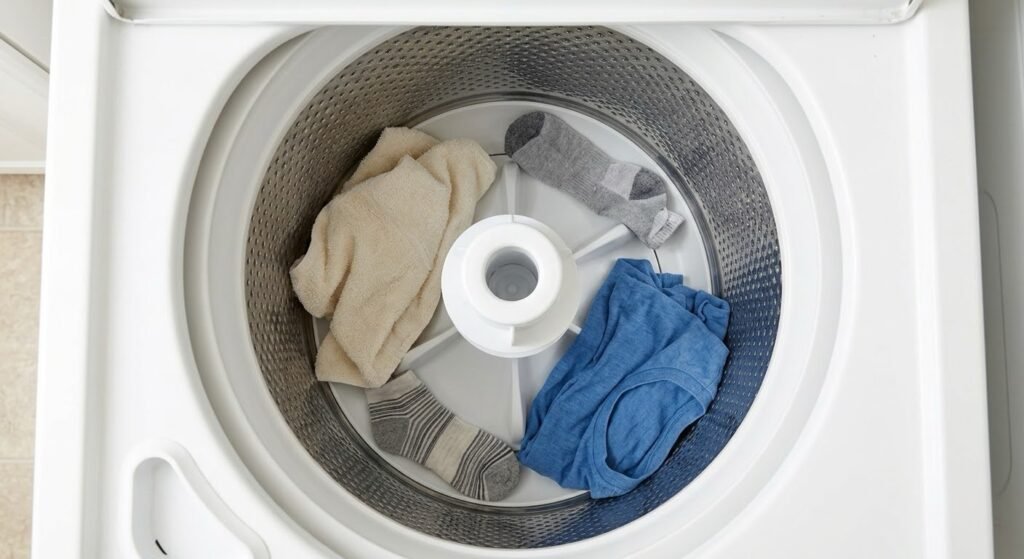
- Don’t mix heavy and light items. A bath towel and a t-shirt move at completely different rates and end up wrapped around each other.
- Match water level to load size. Too little water for the amount of laundry means nothing can move freely.
- Never drape clothes over the agitator. Drop them in loosely around it. A mesh laundry bag helps for items that tangle badly, like long sleeves and drawstrings.
- Avoid both overloading and underloading. Either extreme restricts the movement that keeps a load from knotting.
When Cleaning Isn’t the Answer Anymore
If the odor survives two full cleaning cycles and consistent lid-open habits, something else is going on — usually drainage. And if the rubber seal around the lid opening is visibly cracked or split, it’s holding moisture instead of shedding it, and no amount of scrubbing changes that.
Call a technician when:
- Water is leaking from underneath the machine rather than staying in the tub. That points to a hose, pump, or tub seal.
- The smell returns quickly despite a genuine deep clean and good habits.
- The machine is still under warranty — check the terms before opening anything up, since some self-repairs void coverage.
Frequently Asked Questions
Q. How long does the lid actually need to stay open?
A. Long enough for the interior to dry, which for most machines is an hour or two. Leaving it open until the next load is simplest, but if that’s not practical in your space, an hour after the cycle ends is far better than closing it immediately.
Q. Can I use vinegar instead of a commercial cleaner?
A. For routine maintenance, often yes — GE lists it as an option. Just never in the same cycle as bleach. Samsung, on the other hand, generally recommends running Self Clean with no additives at all, so check what your manual says before adding anything.
Q. My washer is high-efficiency. Does that change anything?
A. It makes detergent choice matter more. HE machines use less water, so non-HE detergent produces suds the machine can’t rinse away, and the residue stays behind. Otherwise the same habits apply.
Q. Does my top-loader have a pump filter to clean?
A. Generally no. Front-load washers have a drain pump filter behind a panel near the bottom, but top-load models typically don’t. If odor persists on a top-loader, the drain hose is the more likely culprit.
Conclusion
A top-load washer doesn’t need weekly deep cleaning. It needs airflow. Leave the lid open after each load, get the dispenser and drain hose a few times a year, and the musty smell mostly stops being a recurring problem instead of something you keep treating.
If the odor is limited to kitchen cloths rather than the whole laundry load, this guide to freshening sour-smelling dishcloths addresses that specific problem.